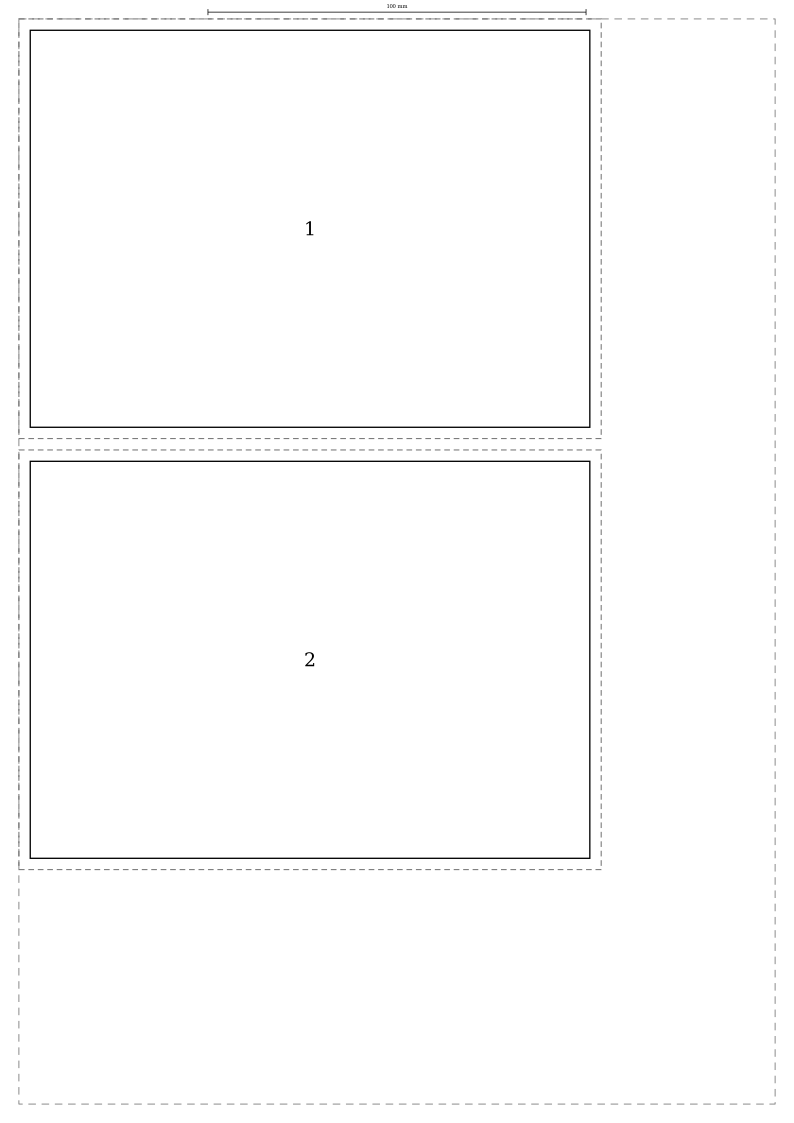
Four is the zero-allowance arrangement
A4 measures 210 × 297 mm. A6 measures 105 × 148 mm. Two A6 pieces across use exactly 210 mm; two down use 296 mm. A four-piece grid therefore has no spare width and just 1 mm of spare height.
This works as a nominal cutting arrangement on blank paper. It does not leave room for independent edge-to-edge artwork, cutting gaps or a printer's unprintable boundary. Open the four-piece nominal plan before adding allowances.
Why a practical allowance can reduce the count to two
For this example, add 3 mm bleed to every edge of every A6 piece. Its footprint becomes 111 × 154 mm. A 5 mm margin on all sheet edges leaves a usable A4 rectangle of 200 × 287 mm. Keep an extra 3 mm between the bleed footprints.
| Setting | No allowances | Worked print example |
|---|---|---|
| Finished piece | 105 × 148 mm | 105 × 148 mm |
| Bleed footprint | 105 × 148 mm | 111 × 154 mm |
| Usable sheet | 210 × 297 mm | 200 × 287 mm |
| Gap between footprints | 0 mm | 3 mm |
| Constructed arrangement | Four pieces | Two rotated pieces |
Rotate the footprints to 154 × 111 mm and stack two. The occupied rectangle is 154 × 225 mm, because 111 + 3 + 111 = 225. It fits comfortably inside 200 × 287 mm, while preserving the A6 trim size.

Why three cannot fit under these assumptions
This particular limit can be checked without relying on a packing heuristic. Every footprint is at least 111 mm wide, whichever way it rotates. Two cannot sit alongside one another inside a 200 mm usable width. Their vertical intervals must therefore stay separate.
Three pieces would need at least 3 × 111 = 333 mm of height, even before adding gaps. Only 287 mm is available. For these dimensions and separate rectangular bleed footprints, three is impossible. A two-piece placement is therefore sufficient to establish the count for this case.
If you need more per sheet without changing the finished size, compare the A3 example. Do not silently scale A6 down to reach a preferred count. Use the printer's actual margin requirement, confirm whether bleed and extra gutter are both needed, then print a measured test at actual size.
Sources and calculation method
- ISO 216:2007 identifies the trimmed A-series standard. Adobe's published A-series table supplies the nominal millimetre dimensions used here.
- Adobe: set a print bleed explains artwork extending beyond the finished trim. The 3 mm bleed in our examples is a chosen allowance; use your printer's requirement.
Placements, comparisons and proofs are Paper & Scale's calculations from those dimensions. They assume axis-aligned rectangular pieces at 100% scale, optional 90-degree rotation, separate bleed footprints and the stated spacing. They do not certify a production job.